
When Science Is the Alibi
How race-based data has been used to justify racist beliefs — and what five hundred years of that pattern looks like when you finally name it

“The first principle is that you must not fool yourself — and you are the easiest person to fool.” — Richard Feynman
Science as an alibi for racism
In 1998, a first-year medical student raised her hand in an ethics tutorial. She read about a study conducted in Macon County Alabama by the United States Government in which 600 Black men with syphilis were deliberately left untreated for forty years, so that researchers could document the natural progression of the disease. When the professor failed to mention it, in class she raised her hand and mentioned it as an example of how medicine had used race to justify harm.
Her tutorial leader told her that could not be true, it must be fiction. That could never happen in academia. He must have missed this report published 20 years before that seminar.
That student was my guest this week on the Emerging Scholar Podcast, Dr. Marcia Anderson — now Vice-Dean of Indigenous Health, Social Justice and Anti-Racism of that same medical school, at the University of Manitoba. That story solidified everything I had been reading in Ibram X Kendi’s “Stamped from the Beginning”. A physician trained inside a system that had spent generations producing an intellectual cover for exactly the kind of harm she was calling out. Dr. Anderson’s tutorial leader did not learn Feynman’s lesson and was completely fooled. Or rather did the institution that trained and paid him fool him first?
The false comfort of neutrality
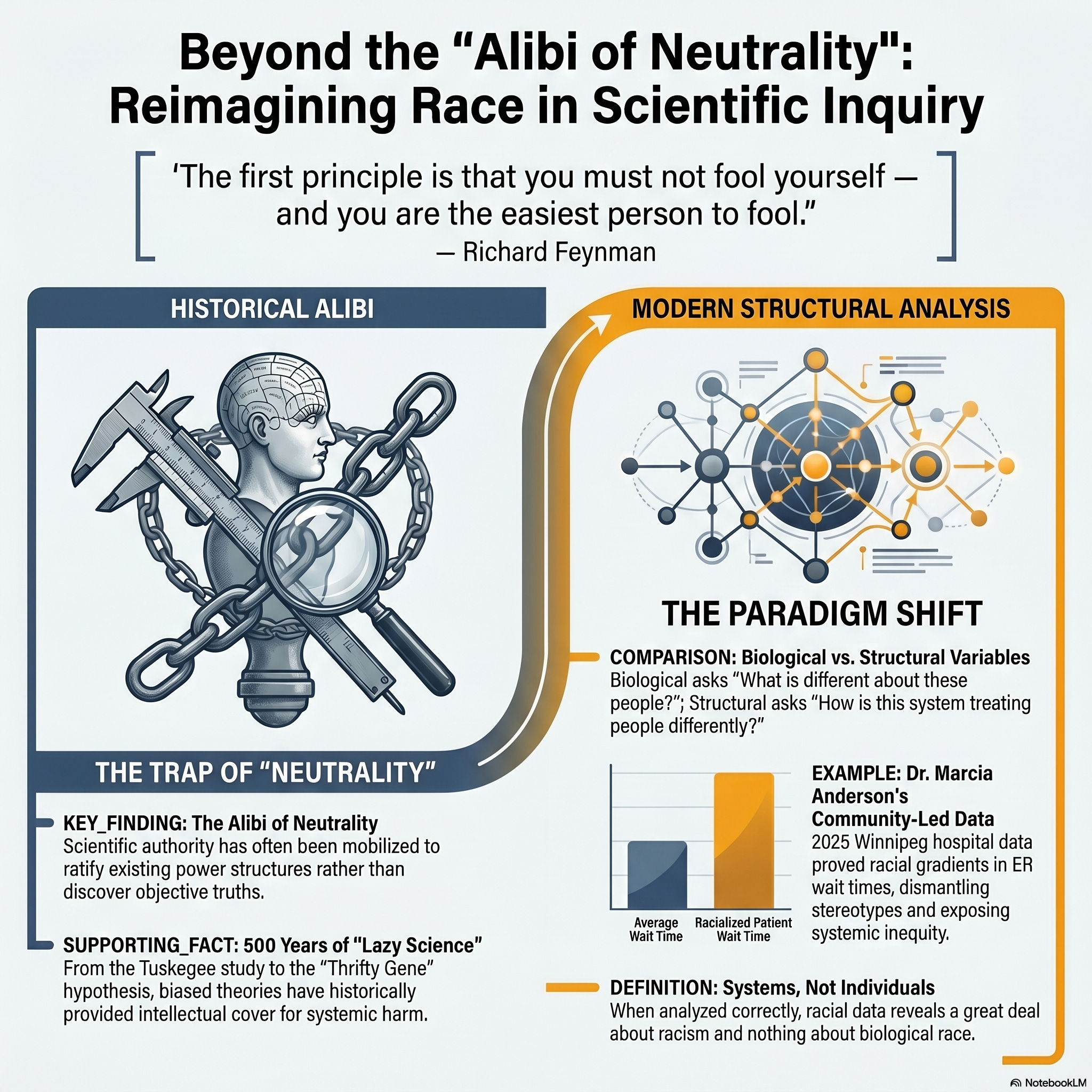
If our greatest strengths are simultaneously our greatest weaknesses, within our discipline of science, neutrality serves that role nicely. For centuries, science has been a cornerstone of society because it is objective and resistant to the temptations of culture and politics. Science has shone a light on the world’s darkest falsehoods and advanced many aspects of our lives. The periodic table, the geometry of the planet and its orbit, the lethality of pathogens, and the miracle of antisepsis — all the result of elegant, neutral experiments. On the flipside, the overuse of scientific neutrality leaves scientists vulnerable to fooling themselves — a vulnerability that went unchallenged for over five centuries as generation after generation sought to prove the false notion that race is both biological and hierarchical.
Over the past few months, I have been diving into the topic of science’s failures when it comes to the question of race. Among everything I read, Ibram X. Kendi’s “Stamped from the Beginning” provided the clearest insight into the harms of believing that the neutrality of science as incontestable. On questions of race, the neutrality of science did not advance our understanding of society. It did the opposite, setting back years of hard-won political progress. This was not an isolated case, science’s role in sustaining white supremacy has been predictably cyclical.
A pattern of upholding falsehoods about race
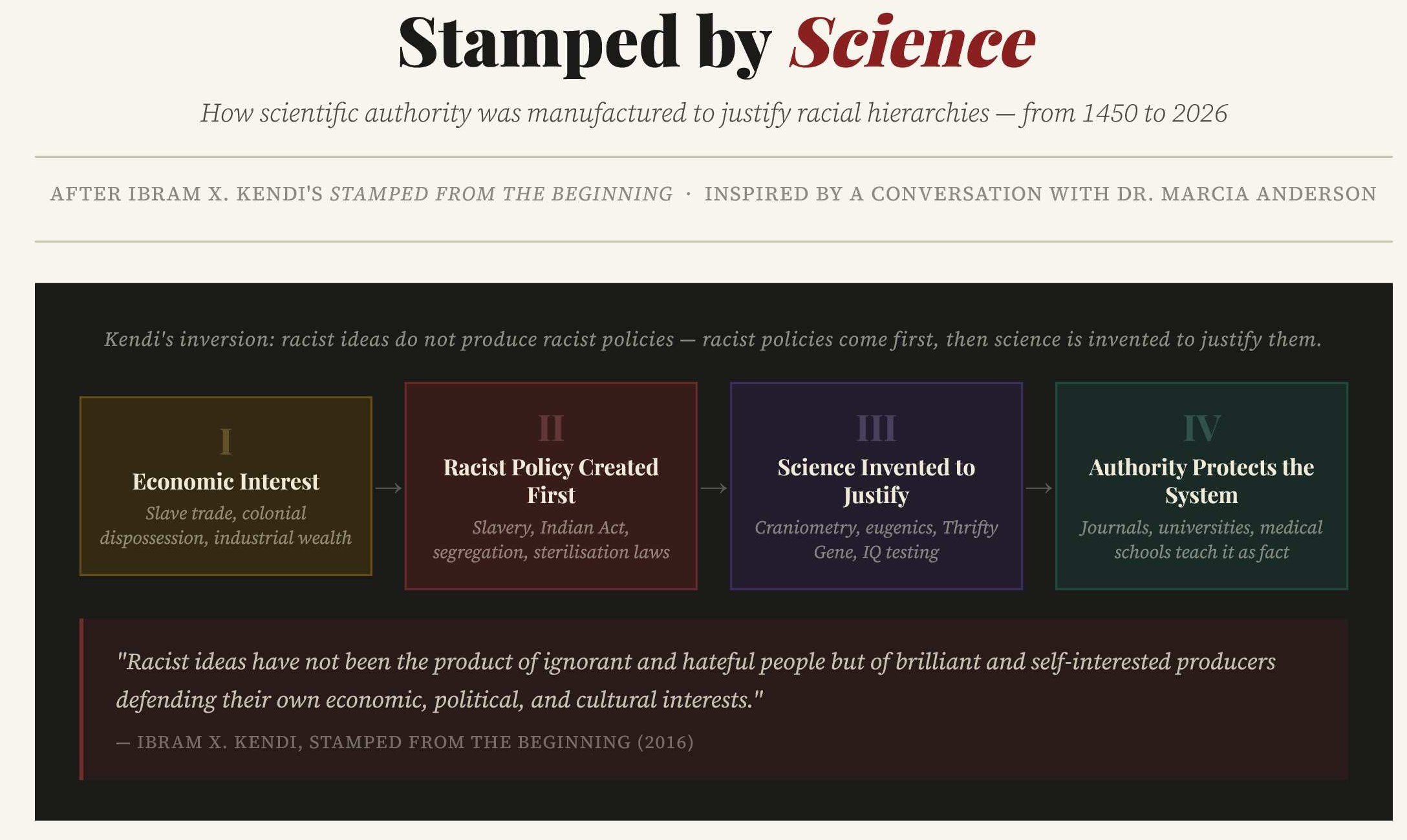
Kendi organises the evolution of racism in America into five distinct eras. Science plays the same role in every one (Figure 1). Each time America achieves a political or legal racial milestone, a scientific study emerges to supply a familiar nuance: there remains biological or social evidence for why people of colour are lesser than. These racist scientific conclusions — which directly contradicted the political advances of the era — were widely accepted as truth. Nowhere was this “Dueling Consciousness” more evident than in Kendi’s chapter on Thomas Jefferson: the president who travelled the world calling for an end to slavery while remaining an active slaveholder for his entire life. What Jefferson needed — what the slaveholding economy of the early republic needed — was for the inferiority of Black people to be scientifically true. And so in Notes on the State of Virginia, he offered is “empirical” observation: that Black people appeared inferior in reason and imagination, though possibly equal in memory. He gave it the form and language of science — and in doing so, transformed a convenience into a credential. When slavery was finally outlawed, the next generation of scientists claimed that racial differences in educational outcomes could be explained by smaller skull sizes. Slavery and lynching were unacceptable — but Black and White people were still not equal. One race was superior to the other. Science said so.
Figure 1. Science’s role in maintaining the notion of racial hierarchy.
The pattern repeated itself from Jefferson to JFK. In every era — from craniometry to eugenics to the Thrifty Gene — scientific authority was mobilised not to discover truth but to ratify existing arrangements of power, organised by race (Figure 2).
After Jim Crow laws were dismantled, differences in IQ test scores “proved” superior intelligence of whites. In the 1960s, as Indigenous people in Canada gained full voting rights, researcher James Neel proposed the Thrifty Gene Hypothesis: that Indigenous peoples carry genes evolved during periods of feast and famine to store energy efficiently, and that these same genes now predispose them to diabetes and obesity in environments of food abundance. It was viewed as an elegant theory that seemed to follow the structure of evolutionary logic. It was published, cited, and taught to both me in graduate school and Dr Anderson in medical school. A “neutral” theory, grounded in the falsehood of white supremacy. And like every claim of biological differences between the races that came before it, it was wrong.
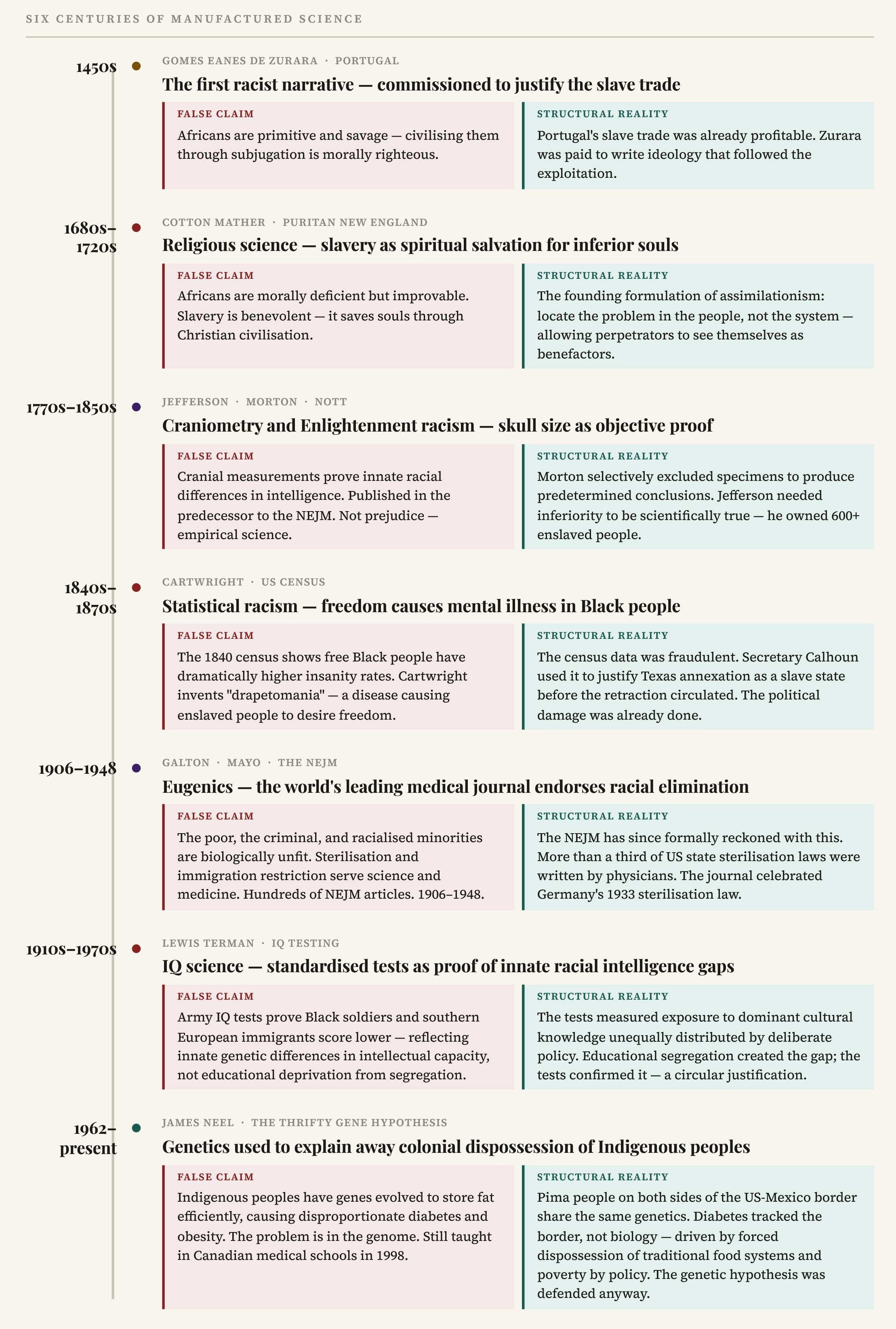
Figure 2. The long history of science as an alibi.
Were generations of scientists that focused on racial differences, in Feynman’s words, fooling themselves? Or were they revealing some deeper truth about society? Regardless of political, religious, or scientific affiliation, white scientists based their theories on the assumption that racial hierarchy was possible and could be baked into human biology. That assumption combined with the cloak of neutrality rendered them and the field of science fallible.
Why does this matter today? Because the vestigial traces of science as an alibi for racial hierarchy remain. In 2008, at the height of the H1N1 pandemic, scientists proposed that Indigenous patients had unique immune systems rendering them more susceptible to disease. In each case, scientists developed biological theories, research questions, and datasets about racial differences without ever examining the systems that produced them. Indigenous scholars called for the opposite, examining the structures not individuals and came up with different conclusions. Today’s interview with Dr. Anderson explores what it looks like when this scientific approach is done at scale. Any differences between racialized groups reveal a great deal about racism, and nothing about race.
The way a scientist asks a question inevitably informs the answer. Race used as a biological variable asks: what is different about these people? Race used as a structural variable asks: what is different about how this system is treating people of different races? The first question has a five-hundred-year history of producing answers that harm the racialised communities being studied. The second examines how systems treat the communities they are meant to serve. The way science and scientific teams are organised will determine which of these questions gets asked — and what the answer reveals about our society.
Breaking the cycle of science upholding racist theories of biology and hierarchy
How can science break from the past? Dr. Anderson provides two elegant examples of comparing outcomes between racialized groups, done the right way, with the right teams, can provide a more accurate answer about questions of race.
The first example comes from Manitoba’s response to the COVID-19 pandemic. In 2020, while communities across Canada were calling for race-based data, Dr. Anderson and a team at the First Nations Health and Social Secretariat of Manitoba took action. Working alongside provincial public health teams, they reported on differences in trends, infection risk, and policy impacts for First Nations communities. The data was revealing. First Nations families were disproportionately affected by every dimension of the pandemic — driven largely by overcrowded housing and impossible social choices, such as whether to go to work and risk infection or stay home and be unable to feed their children. Vaccine policies and social supports were developed based on the results and improved the Provinces reponse. Critically, the interpretation was led by members of the communities being studied. (see Podcast on this topic from NCCIH here) That is the key difference from the science of centuries past. The questions, the data, and the interpretation were in the hands of the people living inside the systems designed to oppress them. They uncovered the mechanics underlying systems of oppression and their impact on the health of First Nations families.
The second example is a direct legacy of that work. In 2025, Dr. Anderson in collaboration with Dr. Delia Douglas and a diverse team of partners released the results from Canada’s first widespread collection of race-based data in hospital settings. Led by a team of Indigenous and Black scholars, community leaders, and patient partners, the study reported emergency room outcomes by race across Winnipeg hospitals. The team found significant racial gradients in wait times and in the proportion of patients leaving without being seen (Figures 3 and 4 below). They also directly dismantled persistent racial stereotypes about the inappropriate use of emergency services. The data could not be shaped by the assumptions of external administrators or researchers — every aspect of this quality improvement initiative was governed by the communities being studied. The data proved what their community had been saying for years-they were being treated differently, lesser than.
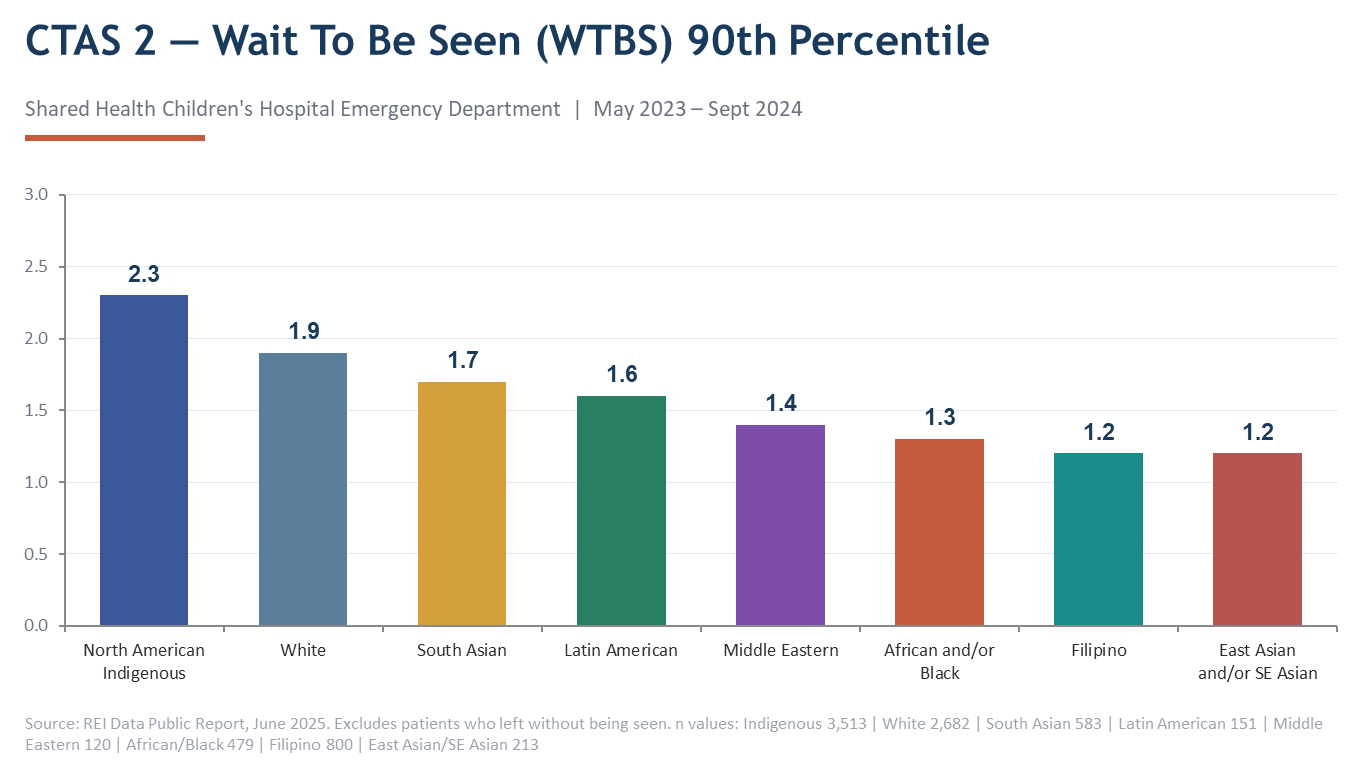
Figure 3. Racial disparities in times for children seen in Children’s Emergency Department in Winnipeg.
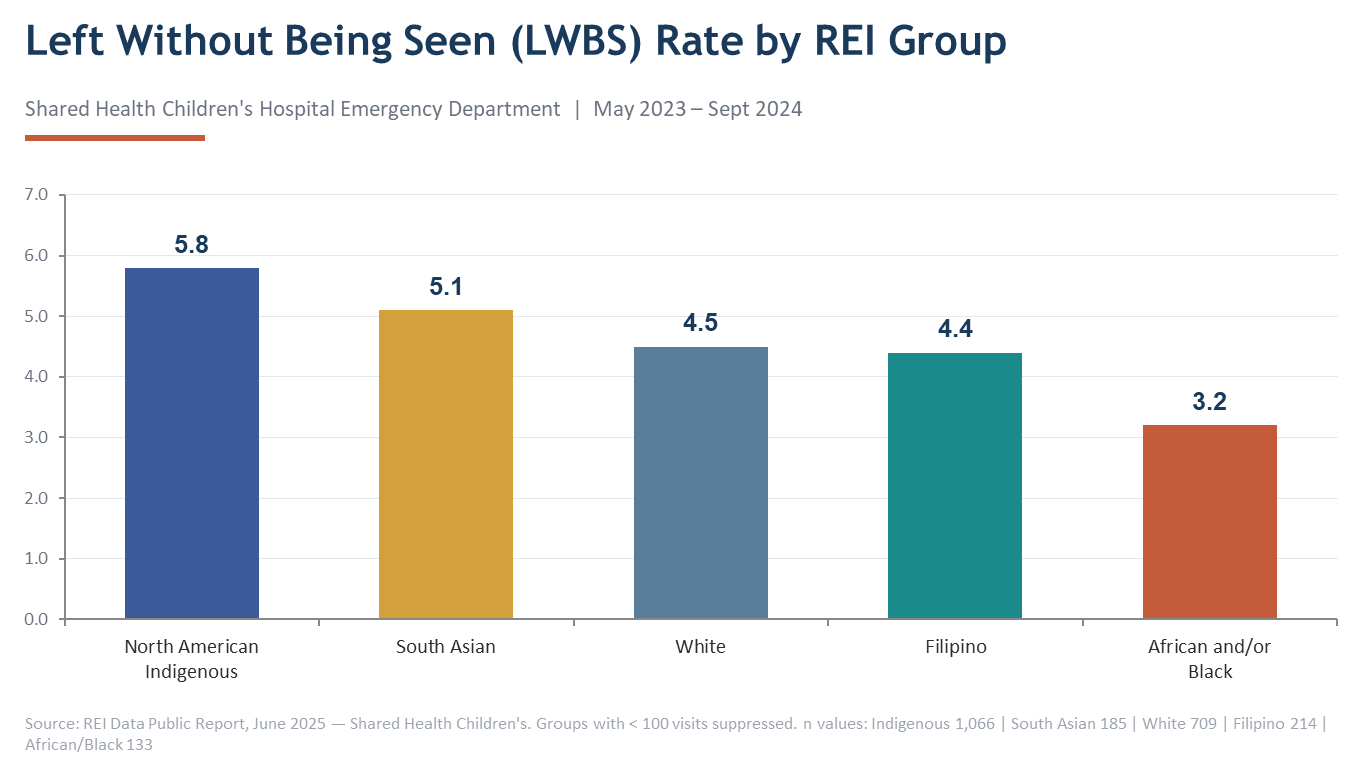
Figure 4. Proportion of families that left without being seen at Winnipeg Children’s Hospital organized by racialized group.
Reckoning with the past
A major reckoning with science’s dark past was published by the “New England Journal of Medicine” in 2023, acknowledging the journal’s own role in perpetuating false claims about racial hierarchy. The NEJM’s synthesis makes this point with unusual directness. Confronted with evidence of health inequities, medical researchers who published in the NEJM over the past century generally attributed the disparities to intrinsic differences between groups — genetics, heredity, or intellectual inferiority. Many emphasised intrinsic causes, the authors write, because doing so absolves researchers and their readers of responsibility for intervening. These scientists did not publish neutral analytical observations. They designed flawed studies and shared biased conclusions that had lasting consequences. Dr. Anderson calls it lazy science. Lazy though it may be, it served as scientific justification for racist leaders, politicians, and physicians who could point to the pages of the world’s most cited medical journal to support their claims. The legacy of these false scientific claims about race is still embedded in our institutions and cannot be erased with a single lecture on health equity.
Inspiration and a road map for Emerging Scholars
Dr. Anderson has been doing this work for thirty years. She did it as a medical student who went and looked up the Tuskegee experiments after being told they were fiction. She did it as a resident who walked into an emergency department and told a physician that the visibly First Nations man he assumed was intoxicated was her father — and that he was in cardiogenic shock. She did it during a pandemic, pushing back against research built on a false theory of Indigenous biological inferiority. She did it for over a decade against institutional resistance, building the infrastructure to prove that Indigenous patients in Winnipeg’s emergency rooms were being treated inequitably — and then releasing that evidence publicly, knowing exactly what it would require the system to confront.
The alibi that science once provided for these disparities — the biological explanation, the cultural hypothesis, the lazy answer that protected the institution — has been dismantled. What remains is the disparity itself, and the question of what we are going to do about it.
As Dr. Anderson said at the close of our conversation: it is time we stand against it. Against the falsehood of racial hierarchy. Against the science that has served as its alibi. Against the institutions that have rewarded that science and silenced those who refuted the conclusions.
The first principle is that you must not fool yourself. We have been fooled long enough. It’s time we use science to dismantle, not hide or protect, the structures that drive the inequities.
Dr. Anderson Has a book coming out in January 2027 called “Lessons from the Lodge”. Please stay tuned for it or check out her Instagram for updates: https://www.instagram.com/the_leaders_lodge/
The podcast episode discussed in this blog can be found here: https://umfm.com/podcasts/the-emerging-scholar-podcast/season-2-episode-16 or wherever you get your podcasts.