Science Needs Storytellers
A lesson in scientific communication and interview with a science communicator

A tale of two scientists and one scientific message
In 1961, two weeks into New Year’s resolutions, Americans opened their mail to discover the face of a physiologist from Minnesota on the cover of their favorite magazine. He looked serious and there was a picture of a heart in the background. The message was clear, there was something important about their health inside these pages. A message weighty enough to be life and death.
In 1960 America was in the afterglow of winning a war, the economy was on a tear and the newly elected president was a global superstar. The future looked bright, but if you were a middle aged man, there was a very real risk that you would die of a heart attack. Everyone knew someone that died from a disease that scientists had a hard time predicting. The man on the cover of the magazine, Dr. Ancel Keys had just published a book about diet and heart health : Eat Well Stay Well. Two things stuck out from his hypothesis and his eventual findings from the Seven Countries Study: Americans were far and away the global leaders in heart attack mortality and there was a sharp, near perfect, association between rates of death and the amount of fat your diet. Before anyone had heard of a “risk factor” for heart disease, Ancel Keys communicated a poignant scientific theory to an entire country: eating fat causes heart attacks. It’s time to change what we eat. His message took off. Americans paid attention, the government bought in and the food industry responded to accommodate the needs of the people. A scientist’s dream. But this begs the question: How did Dr Keys’ message change the entire nutritional landscape of a country? Years of hard fought battles on the front lines of health advocacy? Dozens of high impact scientific papers that educated millions ? Countless hours befriending politicians and long hours behind closed doors with the country’s most powerful law makers?

Perhaps the best way to answer these questions is to examine the career of one of Keys contemporaries at the time, Dr. Paul Dudley White. If you don’t attend American Heart Association meetings, you probably don’t know of White. But if you’ve ever been to Boston and run or walked on along the Charles River, you’ve experienced his legacy. [Of note: He is also the “White” in Wolff-Parkinson-White syndrome]. Like his colleague Keys, a bespeckled and fit scientist with an air of confidence that characterizes cardiologists. His career is a long-list of remarkable achievements. As an assistant professor he helped co-found the American Heart Association. As the director of the National Heart Institute, White was instrumental in the national push that produced the Framingham Heart Study. The study that shaped the way we currently approach heart disease prevention until this day. White was so famous as a cardiologist that in 1955 he was appointed as the personal physician to President Dwight Eisenhower after he suffered a heart attack. Paul Dudley White had everything it takes to bring scientific discoveries to action: evidence in high impact journals, status, a network of powerful individuals to help him sell it to the public and the support of respected institutions to confirm his ideas. In fact, in the 1950’s he published at least 70 articles and The Framingham study literally defined the term “risk factor” in a publication that came out the same weekas Keys’ TIME Magazine article. If Paul Dudley White was the face of cardiology in the 1950’s how did Keys land on the cover?
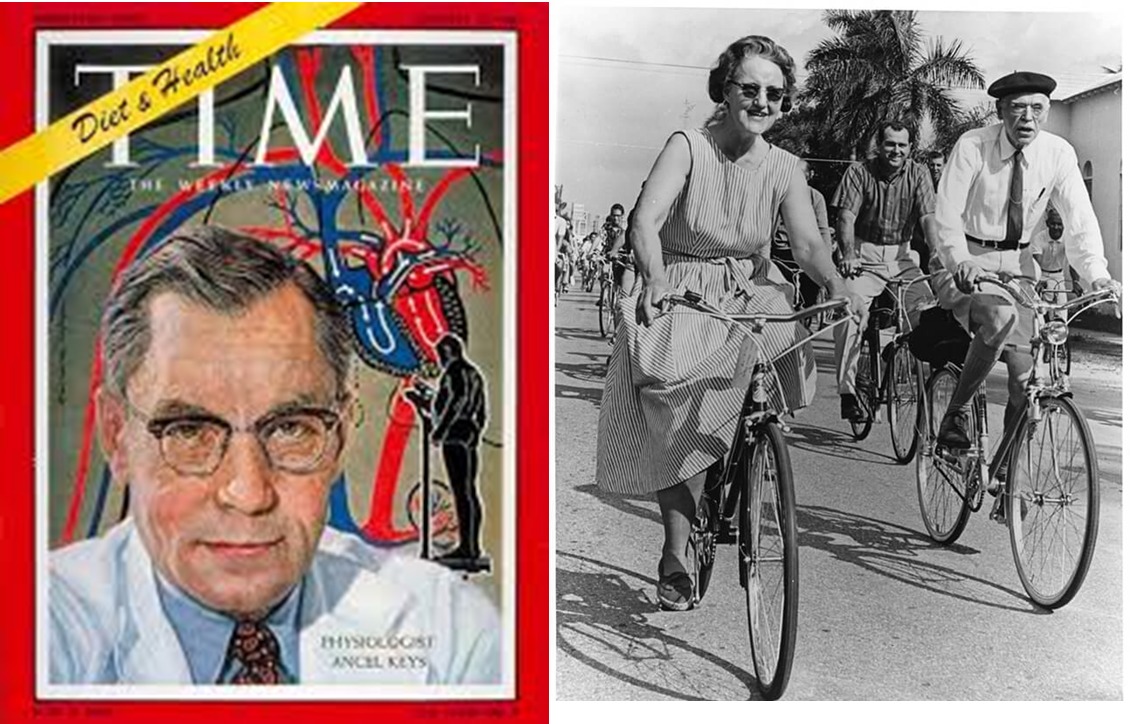
The story teller vs the educator (Keys left - Dudley White right)
The central thesis for today’s post is this: for science to go public it needs story tellers. This blog accompanies a podcast interview with science communicator Krista Lamb, and the key messages she shares provides an answer to that very question.
How does scientific evidence break the tipping point?
From the viewpoint of academics, Paul Dudley White was a giant. A builder, an educator, a calm and reassuring mentor grounded in scientific evidence. Known as the Father of Preventive Cardiology, he was cautious about his messaging, never overselling the science. Keys on the other hand was a scientific renegade. He launched the Minnesota Starvation Experiment in 1944 - an extreme experiment of the biological and psychological effects of losing 25% of body weight. White was reassuring, optimistic. Gently providing Americans with a “prescription for life”: the key to heart health came in 5 essential behavioural shifts: be vigorously active, avoid smoking, sugars and fat, and perhaps my favorite; be optimistic. Keys was urgent, alarming and focused on a single culprit, cholesterol. Keys was less optimistic, calling obesity “disgusting”, communicating with the conviction of a defense attorney. When challenged on his theory he would confidently respond: “I’ve got 5,000 cases. How many do you have?” Yuval Noah Harari argues that storytelling is the ultimate superpower of Homo sapiens and inspires people to cooperate and build tribes, communities, and societies. Keys was a story teller. White, less so. As emerging scholars, this may rub you the wrong way, but we need you to become better story tellers. Here are two short lessons from Krista Lamb and the history of preventive medicine on how to become one.
Lesson #1: Know your audience
Keys knew his audience and that is the first clear message from the final episode of Season 2 of the Emerging Scholar Podcast, a conversation with Krista Lamb. Then, and now, the public wants a message that’s easy to digest. For Keys it was this: “Our friends and family are dying of heart attacks, cholesterol is the culprit, stop eating foods loaded with fats because they drive up your cholesterol” Stop eating these fatty foods and heart attacks will disappear.
White’s message was similar and scientifically grounded but it was not what Americans wanted to hear or could easily understand. White wants us to be optimistic? To be vigorously active? These are vague and messy messages that don’t align with the public’s need for a villain. For Dr. White, this messaging worked well at scientific conferences and grand rounds where the audience was like-minded, and understood the complexity of human biology. The message failed to resonate with the journalists and editors responsible for filling magazine and newspaper pages that would grab their attention.
The risks of poor scientific communication
The consequences for poor scientific communication are real and can be harmful. Take Ignaz Semmelweis scientific discovery as an example. Semmelweis was the Hungarian physician and scientist who famously discovered that postpartum infection could be prevented with handwashing. In his landmark experiment, he reduced maternal mortality rates in the Vienna General Hospital from 18 to < 2%. Semmelweis communicated his results in a book and a serious papers on the topic, but could not convince his colleagues to adopt the science. Mothers continued to die, long after his death. Could deaths have been prevented with better scientific communication? More importantly, for the purpose of this post, why couldn’t Semmelweis convince his colleagues or the general public of his discovery? He had the intervention, and the data to prove it.
Semmelweis’ story was incomplete and his audience needed a mechanism. Germ theory did not yet exist. Semmelweis knew handwashing worked but he could not tell his colleagues why it worked. His audience needed a mechanism to change their ways. They were grounded in scientific evidence and he only had, in their eyes, an interesting observation. In communication terms, he had a conclusion without an argument. His colleagues weren’t just being stubborn; they were being asked to accept an effect with no explanation, and explanations are what make findings feel true. Keys had the mechanism - cholesterol clogging arteries - as imperfect as it was, it was the mechanism people wanted. Keys gave his audience what they needed to buy into his tory.
Semmelweis made his audience the villain. The implication of Semmelweis’s finding was that doctors were killing their own patients. This required the most elegant of stories for it to catch on. How does a doctor convince his colleagues that they are the cause of death without making them feel culpable? It’s very hard to accept a story that paints you as the villain and indicts you for it. Keys did the opposite, he handed Americans an external villain — fat, the modern diet, the food on their plates. Semmelweis accused the members of his own team of causing harm. Keys’ message invites the public into the fight; Semmelweis’ message triggers a defense. Semmelweis did not understand his audience.
Lesson #2: Don’t Bury the Lead - An alternative history of heart disease prevention?
Another famous study that dovetails with Paul Dudley White’s campaign for preventing heart disease was published in the Lancet 1953 with a follow-up in the BMJ in 1958. The results are far more compelling than the ecological associations published by Keys, but had a fraction of the impact. Jerry Morris, a Scottish epidemiologist was one of the first investigators to leverage the concept of “triangulation”, in his study of physical activity and coronary heart disease. Comparing rates of coronary artyery disease between conductors and drivers of Central London buses, Morris found that the conductors, who walked the bus taking tickets (active) experienced 50% lower rates of coronary artery disease, than their peers that drove the buses (sedentary). He also found a nearly identical difference in rates of coronary heart disease between postmen (active) and telephonists (sedentary) across England, clearly demonstrating that sitting all day at work doubled your risk for heart disease. In 1958 he told us how it worked. Morris and his colleagues analyzed the coronary arteries and heart tissue from over 3800 civil servants, finding that ischaemic myocardial fibrosis was reduced by well over 50% for individuals working in “heavy occupations” compared to those in “light occupations”. The mechanism was clear, sitting all day increased a persons risk for myocardial ischemia and ischaemic myocardial fibrosis. Despite their compelling nature, these discoveries did not catch the public’s attention in quite the same way as Keys’s hypothesis did, perhaps because of the second core element of good scientific communication according to Krista Lamb: Morris buried the lead.
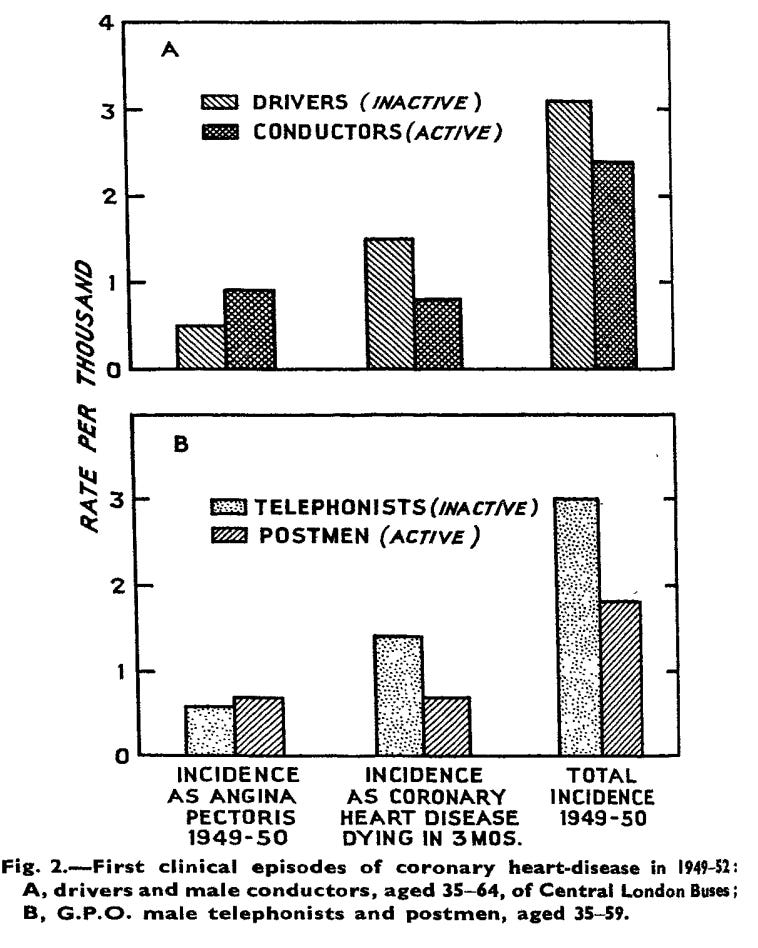
Results from Morri’s famous 1953 paper in the Lancet comparing coronary disease mortality between active and sedentary public servants.
Jerry Morris, had arguably one of the most convincing cases to support Paul Dudley White’s call that vigorous exercise is a fountain of youth, or at least an easy way to stave off heart disease. It was published in the most respectable journals and he published a book about it. It science came from real-world evidence, not a carefully controlled laboratoy experiment. Unfortunately, he did not seem that interested in the message, because his passion was the science.
When you read the studies by Morris and the interviews he gave, it was obvious that he was the consummate scientist. Cautious, calculated, and rigorous. Morris loved science and grounded his work in his hypothesis not the broader implications of his findings. Here is a section of an introduction from his 1958 paper: “The hypothesis was previously stated that men in physically active jobs have a lower incidence of coronary heart disease in middle-age than men in physically inactive jobs. More important, the disease is not so severe in physically active workers, tending to present in them in relatively benign forms. The investigation now reported deals with the relations between physical activity of work and the frequency of ischaemic myocardial fibrosis in a sample of 3,800 middle-aged men dying from causes other than coronary heart disease.” Morris loved the science so much he buried the lead in it.
Imagine what Keys would have done with that data. When questioned about his findings: “I have samples from the hearts and coronary arteries from 4000 corpses. How many do you have?” “Sitting kills”. “Your chair is the enemy”. If Keys led this work, or if Morris had spent more time on the story, could physical activity have superseded cholesterol in the minds of Americans and what would that version of history look like?
Story telling comes with a responsibility
The story of Keys does not end with a war on cholesterol. As we discussed in an earlier Emerging Scholar blogpost, the story told was not grounded in the best science. The narrative that cholesterol was the source of America’s problem with obesity and heart disease was oversold and had consequences. A closer look at Keys data revealed a less perfect picture of the links between diet, cholesterol and heart disease. Keys impatient conclusions and over commitment to the data he presented, not the actual data at hand may have done more of a disservice to the health of America. As America waged war on cholesterol, it turned to alternatives like high-fructose corn syrup. As Keys message made villains out of butter, whole milk and steak, the food industry replaced them with chemical alternatives labelled “cholesterol free”, inadvertently creating a different health crisis. The epilogue offers another lesson for scholars: the storytelling needs to be as compelling as the science behind it — but no more compelling than that. And the narratives of alternative voices need to be heard. Balancing Keys' message against those of Morris and Dudley White would have done more for the health of Americans than the singular focus on a single villain. What if we had married the communication skills of Keys with Morris’ passion for the method, and Dudley White’s skills as a mentor and educator? What would the public’s view of heart disease prevention look like today? As scholars, I believe we have a responsibility to unite communication, scientific rigour, and temperament in service of bringing our discoveries to life.
The Take Home Message
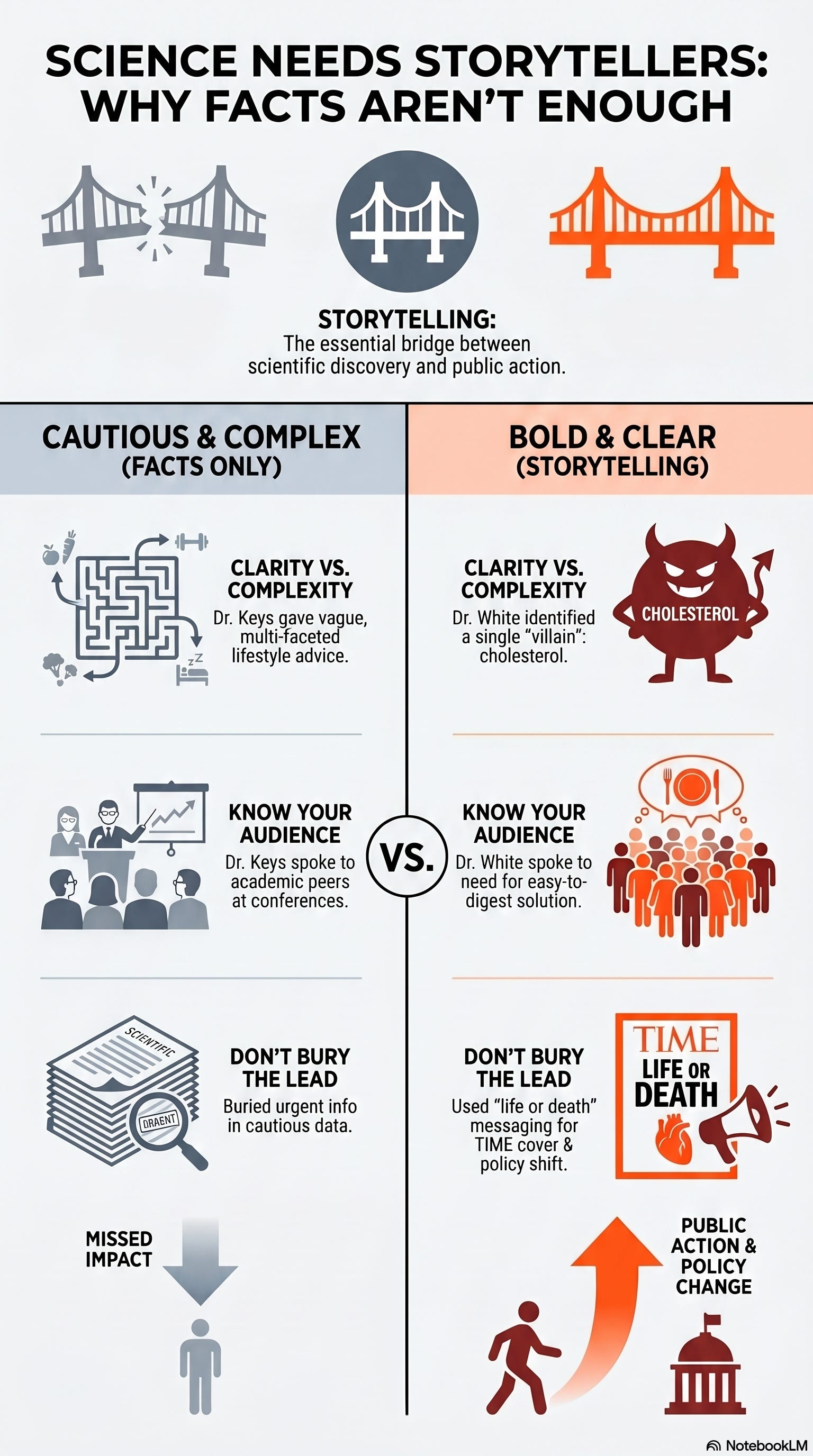
A summary of the lessons learned from my interview and the storties here is summarized below. Beyond the teaching tips, in this day and age of mounting scientific evidence coupled with the constant presence of social media, scientists cannot afford to let their science do the talking. We need scientific story tellers. There are many who have paved the way before us. They got society excited about science and perhaps we can learn from them. Craig Venter famously got a nation excited about the human genome by starting a race. Siddhartha Mukherjee is telling the stories and the humanity behind the scientists that are waging war against cancer, exploring the inner reaches of the human genome and our cells. Ibram X Kendi is retelling the American history of science and racism. Jennifer Doudna is reframing the way society understands gene therapy. These story tellers provide templates for how you can tell your own story as an Emerging Scholar. Now you tell me, what is your story?